Software as sadaqah jariyah.
Baqiyah builds things for the ummah and gives them away. No ads, no tracking, no paywall, no account required. Everything we make is free, and stays free.
ٱلْمَالُ وَٱلْبَنُونَ زِينَةُ ٱلْحَيَوٰةِ ٱلدُّنْيَا ۖ وَٱلْبَـٰقِيَـٰتُ ٱلصَّـٰلِحَـٰتُ خَيْرٌ عِندَ رَبِّكَ ثَوَابًۭا وَخَيْرٌ أَمَلًۭا
“Wealth and children are the adornment of this worldly life, but the everlasting good deeds are far better with your Lord in reward and in hope.”
Baqiyah comes from al-baqiyat as-salihat, the enduring good deeds.
Across Minbar, Buruja and Salattid, updated automatically on 10 August 2026. Counted per site, so anyone who uses two is counted twice. Social reach is counted by hand.
What we do
We remove what stands in the way.
Between a Muslim and their deen there is often something in the way. It is rarely belief. It is something ordinary.
- You do not know when to pray, and the week runs you.So we put the prayer times inside the calendar you already live by.
- You do not understand the khutbah.So we translate it, live, into your language, without changing a word the imam says.
- You want to learn, and everything good is behind a price or an advert.So we wrote it all out and gave it away.
Language, time, money, access. Different walls, one job.
The problem
You have felt this.
You open an app to read Qur'an. There is a banner between you and the ayah. A video plays before the tafsir loads. It wants your location, your contacts, your email. The hadith collection is behind a subscription. The translation you wanted is in the paid tier.
Somewhere in there, the thing you came for got smaller.
The deen was given freely. The tools that carry it should be too.
Why software
A well, dug once.
The oldest picture of sadaqah jariyah is a well. One person pays for it, and a village drinks for a hundred years. The reward keeps arriving long after the hands that dug it are gone.
We think software is the new well.
A well serves one village. A page that teaches Qur'an serves anyone with a phone, in every language, in every timezone, at three in the morning, forever, and it costs almost nothing to serve the next person. Write it once. It keeps giving.
إِنَّا نَحْنُ نُحْىِ ٱلْمَوْتَىٰ وَنَكْتُبُ مَا قَدَّمُوا وَءَاثَـٰرَهُمْ
“It is certainly We Who resurrect the dead, and write what they send forth and what they leave behind.”
The word there is athar: the trace, the mark left behind, the thing that keeps moving after you have stopped. That is what we are trying to build.
إِذَا مَاتَ الإِنْسَانُ انْقَطَعَ عَنْهُ عَمَلُهُ إِلاَّ مِنْ ثَلاَثَةٍ إِلاَّ مِنْ صَدَقَةٍ جَارِيَةٍ أَوْ عِلْمٍ يُنْتَفَعُ بِهِ أَوْ وَلَدٍ صَالِحٍ يَدْعُو لَهُ
“When a man dies, his acts come to an end, but three: recurring charity, or knowledge by which people benefit, or a pious child who prays for him.”
Two of those three are what we do all day.
Already running
Three things, already running.
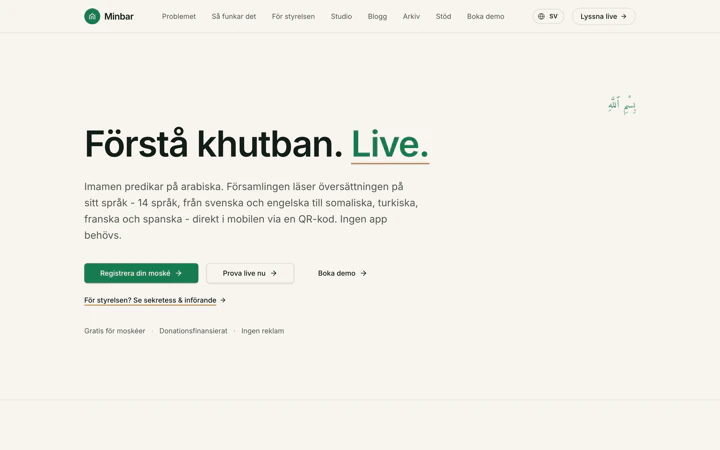
Minbar
getminbar.com
The imam preaches in Arabic, as he always has. The congregation reads it in their own language, live, in fourteen languages, by scanning a QR code at the door. No app. Nothing changes about the khutbah itself. Free for every mosque, always.
More about Minbar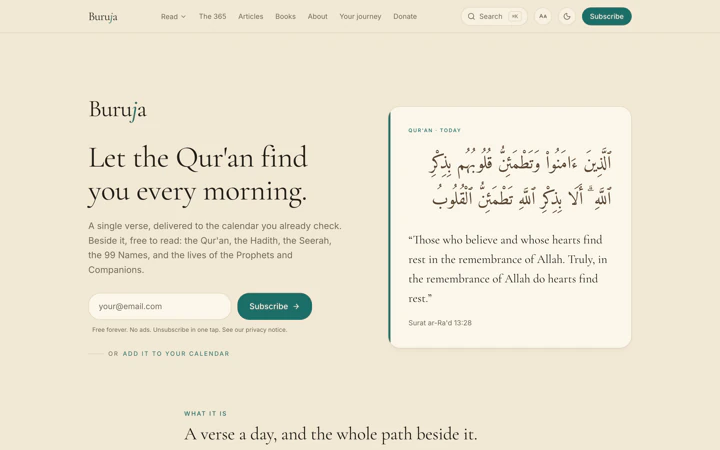
Buruja
buruja.com
The Qur'an, the seerah, the companions, the prophets, the 99 Names, the forty hadith, Riyad as-Salihin, and a verse a day delivered to the calendar you already check. Free, no account, no ads. There is even a free API.
More about Buruja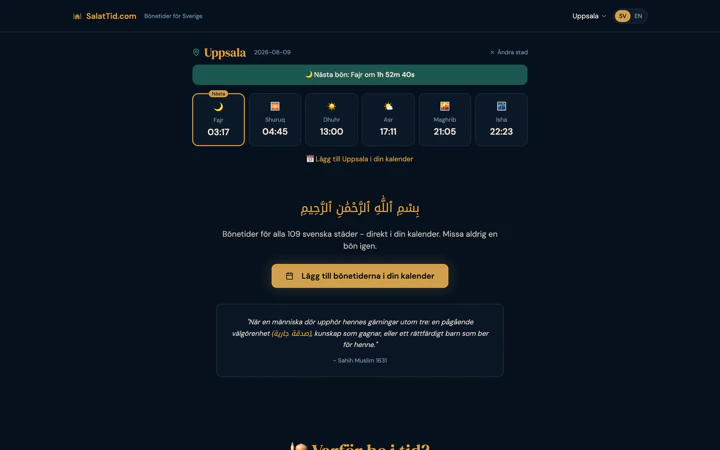
Salattid
salattid.com
The meeting is booked for one o'clock, and so is Dhuhr. Salattid puts the prayer times into the calendar you already live by, so they stop moving. Your colleagues see busy. One hundred and seventy one cities.
More about SalattidWhere we are
It works. Not enough people have found it.
The average visit across the three runs 3:43, and 7 in 10 go on to read something else rather than leaving. On Buruja alone it is 4:30 and 8 in 10: a reading library holds people longer than a prayer time lookup, and it should.
We think that is simply what happens when nobody puts an advert in the way.
Last month, 1,058 people used something of ours. Over the same month, with nothing spent on advertising, our posts were seen on Instagram by 21,000 people, and viewed 31,000 times.
There are nearly two billion Muslims.
That gap is not a content problem. It is a reach problem, and reach costs money.
The List
Things that should exist, and do not.
This is the part of the site we care about most. It is not a roadmap and it is not a promise. It is an honest list of gaps we can see.
When something is funded, we build it. When it ships, it moves to the top and stays free forever.
- 01A Qur'an that works with no internet.Most of the ummah is not on fast, cheap data. An app that downloads once and then never asks for a connection again, for the places where every megabyte is counted.
- 02The seerah, for children.The life of the Prophet, peace be upon him, told properly for a seven year old, in ten languages, free to every parent and every weekend school.
- 03A revert's first year.Not a doctrine dump. A gentle path through the first twelve months, one step at a time, written for someone who has nobody at home to ask.
- 04Salattid, wherever the week runs you.One hundred and seventy one cities so far. The same working week runs Muslims in every city in Europe and North America, and their calendars are just as empty of salah.
- 05Minbar, in more mosques.Fourteen languages already work. What is missing is not the technology, it is the mosques. Every city has a congregation sitting through a khutbah it cannot follow.
- 06Buruja, in more languages.Everything we have already written, carried into the languages that never get the good version. Not the five that always get translated. The other ones.
- 07A companion for memorisation.For the person carrying the Qur'an in their chest, and the teacher walking beside them.
Something missing?
Some of what we have built started with one person saying I wish there was. If you can see a gap we cannot, tell us. We read everything.
Money
Where the money comes from, and where it goes.
Baqiyah is a registered non-profit in Estonia. No one takes a profit. There are no investors to answer to and nothing to sell you, because you are not the product.
Everything we make is free at the point of use, to every person and every mosque, including the mosques that could pay and the ones that never could. We would rather be small and free than large and charging.
So the work is paid for by people who choose to carry it: individual donors, mosques who give what they can, and grants for the parts of this that serve the wider public good.
The costs, the position on zakat, and what we will not do are all set out on the transparency page.
Give
Give, and share in it.
مَّثَلُ ٱلَّذِينَ يُنفِقُونَ أَمْوَٰلَهُمْ فِى سَبِيلِ ٱللَّهِ كَمَثَلِ حَبَّةٍ أَنبَتَتْ سَبْعَ سَنَابِلَ
“The example of those who spend their wealth in the cause of Allah is that of a grain that sprouts into seven ears, each bearing one hundred grains. And Allah multiplies the reward even more to whoever He wills.”
21,000 people saw something of ours on Instagram in the last thirty days, and we spent nothing to reach them. Not because we are clever, but because we have not yet had anything to spend.
Money here does not buy servers. It buys distance. It puts a verse in front of someone who has never seen one, in a country we have never been to.
مَنْ دَلَّ عَلَى خَيْرٍ فَلَهُ مِثْلُ أَجْرِ فَاعِلِهِ
“One who guides to something good has a reward similar to that of its doer.”
And it is not only ours. Every person who reads because you gave, that is written for you too.
Who
Who is behind this.
Rafi Mohammad writes the code and most of the words.
Born in India, lives in Tallinn. He builds software for a living, through his own company in Estonia, and most of what he has shipped has nothing to do with any of this.
Baqiyah is the one he does for nothing. No salary, no invoices, no client work touching it. He is on the board because somebody has to sign the papers.
Farhan Mohamed Ali is a co-founder, based in Sweden.